
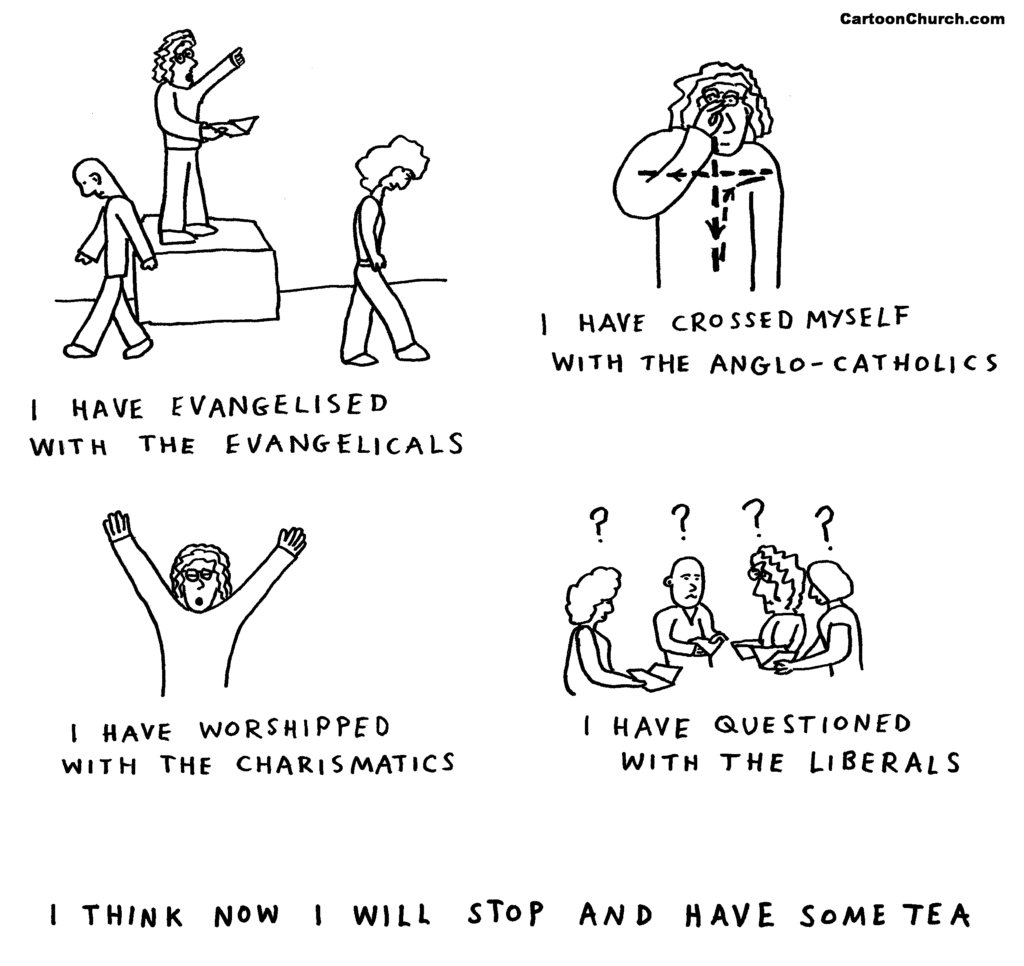
If you spend any amount of time within the Church of England, or the church in general, you will have likely come across various labels such as “evangelical”, “catholic”, “charismatic”, “liturgical”, “central”, “liberal”, “conservative”, “modern”, “traditional”, “progressive”, “orthodox”, “inclusive” and more. You may hear such terms applied to individuals, to local churches, to theological colleges, to national networks and institutions, or even to entire Christian denominations. And your reaction to each may be positive, negative, neutral – or just confused!
Now on one level, it makes sense for this kind of terminology to exist. There is a huge diversity within Christianity, and there is a natural human tendency to want to understand, categorise and label this diversity. And on one level, this language does usually communicate something about whatever or whoever is being described.
The problem is that language isn’t always as precise as we’d might like it to be. The meaning of words shift over time, and in different places. And in these cases, the nuance often changes depending on whether the word is being used by a supporter or an opponent of that tradition.
Returning to the Church of England specifically, there are clearly marked differences between the “extremes” of different traditions. To take a local example, if you were to worship at St Mary Magdalene’s or St Barnabas’ on one Sunday (“high” Anglo-Catholic), and then at St Aldate’s or St Ebbe’s (“low” evangelical) on the following Sunday, you might be surprised to find that they were even in the same denomination.
And sometimes the distinctions we find are fundamental and mutually incompatible. Two major recent examples in Anglicanism in recent decades have been the ordination of women and the validity of same-sex marriage and relationships. These are issues where different beliefs are difficult to reconcile – and in the case of St Giles’ and St Margaret’s, both proud members of Inclusive Church, our collective views are (hopefully!) very clear.
On the other hand, one’s views on how the clergy should be dressed during a service, or what sort of music is suitable for worship, might be seen, not as unimportant, but perhaps as secondary and contextual.
One of the most important dividing lines between Christian traditions and denominations relates to sources of authority. Anglicanism is sometimes described as a “three-legged stool” based on the authorities of (a) Scripture; (b) the tradition / teaching of the Church; and (c) individual human reason – to which is sometimes added a “fourth leg” of personal experience.
Perhaps a useful modern metaphor is that of an audio mixing desk, where different sliders change the volume of different audio sources.

With this image, we can imagine different traditions “turning up” or “turning down” particular sources of authority, or other distinctive aspects of the faith. Such an image stresses how much we can learn from other traditions within the Church, which may emphasise different aspects to us. We can then view these other traditions not as a threat to us, but as a gift – an invitation to step into a wider understanding of the God who is beyond all human understanding – or labels!
When I applied to the Benefice – in 2019 as an Associate Priest and as 2021 as Vicar – the churches were described in the information pack as “liberal catholic” (St Margaret’s) and “central” (St Giles’). There is certainly some truth in those descriptions, and I think it’s no bad thing for parishes to proudly own the tradition which reflects their history and identity – as long as they can also recognise that such labels can either exaggerate, or underplay, distinctions with neighbouring parishes. Labels can be helpful in describing our history and style, but they never define who belongs here. People come to St Giles’ and St Margaret’s for many reasons, not always anything to do with a defined “tradition” – and all are welcome, whatever they identify “with” or “as”.
In the end, while it is important to understand and respect the sincerely held differences that exist within our faith, we must never lose sight that we follow the same saviour, our Lord Jesus Christ. As we explore these traditions together, my hope is that we grow not only in understanding, but in generosity toward one another and our fellow followers of Christ.
This is the first of a series of posts examining some of these different labels – where they come from, what they mean, and how useful they might be to us today. Next up: “catholic”!