
Revd Dr Siân Grønlie, benefice Curate, writes:
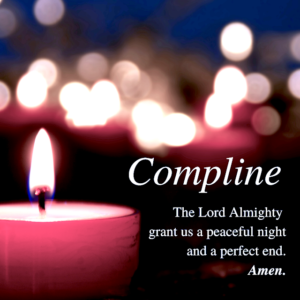
About a week or so into the first lockdown, a group of us from across the benefice (together with some friends from the parish of Stonesfield) decided to meet online every Monday evening to say the ancient office of Compline together. This is an office that I’ve grown to love very dearly, not only because of the support and comfort we as a small group were able to offer to one another over a worrying time, but because the words and prayers of this office offer a gentle way of entrusting ourselves and each other to the love of God in the sure knowledge of his protection.
The word Compline comes from the Latin completorium, referring to the completion of the waking day. Its origins lie in the simple practice of reciting a prayer before sleep, and probably go back to mid-fourth century, although it was St Benedict in the sixth century that gave it its basic structure. It was the last of the seven canonical hours observed in monasteries throughout the West, and it would have been followed by the ‘greater silence’ until Terce (9am) the following day. When Cranmer revised the monastic hours in the sixteenth century so as to reduce them to two daily offices which all laypeople could say, he merged Vespers and Compline to create the service that we now know as Evensong or Evening Prayer. But in Common Worship there is a contemporary form of Compline, which is what we use in our group on Monday evenings.
The beauty of Compline lies in its rich inheritance from the Psalms, which saturate its language. The Benedictine form of the service centred around three short psalms that remind us of God’s protection and care at night: Psalm 4, Psalm 91 and Psalm 134. The Roman office added to these to a confession and absolution, the beautiful hymn Te lucis ante terminam (translated by J. M. Neale as ‘Before the ending of the day’), a short reading, a responsory based on Psalm 30, and finally the canticle Nunc dimittis or the Song of Simeon. This is the pattern of the contemporary office.
The office of Compline begins with a short period of silence for the examination of conscience as we put the events of the day to rest. We then ask for God’s protection in the words of the hymn:
That you with steadfast love would keep
Your watch around us while we sleep.
To remind ourselves of God’s promises to us, we immerse ourselves in the words of the Psalms, which both assure us of God’s sheltering arms and call us to vigilance:
I will lie down and sleep in peace, for you alone, O Lord, may me dwell in safety (Ps. 4)
You who live in the shelter of the Most High will abide in the shadow of the Almighty (Ps. 91)
Come bless the Lord, all you servants of the Lord, who stand by night in the house of God’ (Ps. 134).
This last psalm recalls to our minds the generations of Christians and faithful Jews who have prayed these words before us and who will pray them in times to come: it reminds us that we are part of a community that stretches across time and space. The reading is usually only a sentence, often the one from Isaiah 30.15: ‘In returning and rest you shall be saved; in quietness and trust shall be your strength’. In today’s busy world, in which we are constantly bombarded with information and overloaded with things we have to do, these are words to treasure quietly in our hearts. Finally, the responsory takes the words that Christ spoke at the moment of his death and encourages them to pray them as our own: ‘Into your hands, O Lord, I commit my spirit’ (Ps. 31). As night approaches, through our natural, human, need to rest and to sleep, we are drawn into the mystery of Christ’s suffering and death, so that, with him, we can share in the mystery of Easter.
At the heart of Compline, though, is the Nunc dimittis, the song of Simeon, which he prayed at the very end of his life when he saw the Blessed Virgin Mary and the baby Jesus in the temple:
Now, Lord, you let your servant go in peace, according to your word. For my eyes have seen the glory of your salvation, which you have prepared before the face of all people, to be a light to lighten the nations, and the glory of your people Israel.
It may seem counterintuitive to move backwards from Christ’s death to his birth, but it is part of the poignancy of this service that, as night falls, it draws us towards the eternal light that can never be overcome by darkness. Simeon has reached the end of his long life, the extinguishing of his own small circle of light, and yet it is at precisely this moment that it is granted to him to see that the dearest hope of his life has been fulfilled. There will be a new and a glorious dawning, a light that will never fade. So we too, at the end of the office, say these beautiful words from Ps. 130:
As the night watch looks for the morning, so do we look for you, O Christ
Come with the dawning of the day, make yourself known in the breaking of the bread
The natural cycle of the day as it ends and begins again, becomes a way of understanding our relationship to eternity. Christ makes himself known every morning, every dawning, and through darkness and death we are moving, always, towards a greater, a more glorious, light.
Compline is a beautiful office, and what began as a short-term project during lockdown has become an ongoing source of nourishment. If you would like to join us, you are most welcome, or if you would like to pray Compline on your own, you can find the service on the Church of England website:
If you would like to join the Benefice compline group, please speak to Siân Grønlie or Anne Holmes.
For other articles by members of our ministerial team, please click or tap below: