
Dear St Giles’ and St Margaret’s church families,
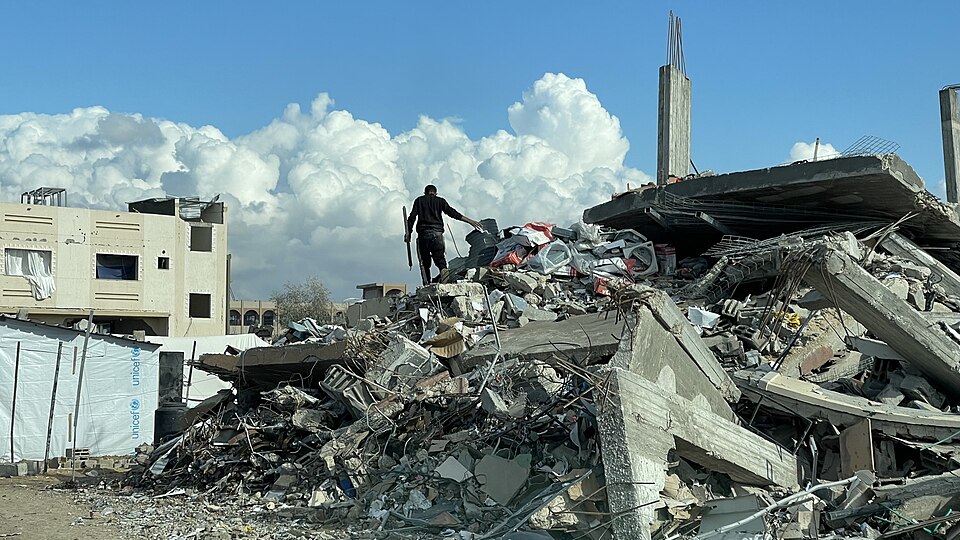

No doubt you will all have been affected in recent weeks, months, years by the violent conflicts in places like Ukraine, Palestine, Sudan and Myanmar. The reports and images we see in our newspapers, TVs and smartphones can often just seem overwhelming. What can we do?
Recently, I’ve noticed one curious point in most reporting on wars, which I’ve never really noticed before – even though it must have always been there. This is the fact that we tend to refer to governments by the name of the country of which they govern.
Sometimes, it is the capital city of a nation that is referred to, particularly in diplomatic reports. “Washington said…”, or “Moscow claims…”, drawing our attention to the particular set of politicians who are in power at that point in time.
But more often, and especially it seems in war reporting, it is the country which is referred to. “Israel attacked…” or “Ukraine defended…”.
Why does this pedantic point of semantics matter? Because how we use language affects how we perceive things. Take the unfolding humanitarian crisis in Gaza, which is often said to be caused by “Israel”. Not “the current Israeli administration” or “Netanyahu and his allies”, but “Israel”, as if an entire nation is of one heart and mind.
I have seen intelligent and sophisticated people, with the best of intentions, follow this slippery slope to automatically designate Israelis or Jews as “baddies” (despite their history, and despite the evidence of many who are opposed to their government’s actions) and Palestinians or Muslims as “goodies” (despite the actions of groups like Hamas). Could the concurrent global rise in violent antisemitism really just be a coincidence?
Generalisations and stereotypes of whole groups of people, whether positive or negative, may make for an exciting Hollywood movie but are ultimately dehumanising, and completely opposed to the way of Jesus Christ. Jesus always recognised the humanity of those he interacted with, whether the poor (uneducated!), prostitutes (disreputable!), tax-collectors (collaborators!), Roman soldiers (oppressors!) or religious or community leaders (hypocrites!). And he sought to help them where they were.
Maybe we are limited in what we can do in the face of global humanitarian crises (although the importance of financially supporting aid charities like Christian Aid can’t be overstated). But one thing we can all do is re-commit ourselves to the way of Jesus Christ – not focusing on our anger and hate centred around national, religious or ethnic stereotypes – but instead focusing on our love and compassion for human beings, whichever ‘group’ they are part of.
Comments
3 responses to “From the vicar (13 August)”
All well and good; but I hope I don’t detect in it the deplorable contemporary slippage of equating objection to Israel’s genocide in Gaza and the West Bank with antisemitism.
VCm
I hope so too, and am not sure how you’d make that leap from that article?
I also hope that no-one would consider condemning antisemitism in our country (and others) and condemning Netanyahu’s approach to Gaza (and the West Bank) as mutually exclusive. Both are opposed to the way of Christ, it seems to me.
Nice point, Daniel. Very nice indeed.