
Dear friends,
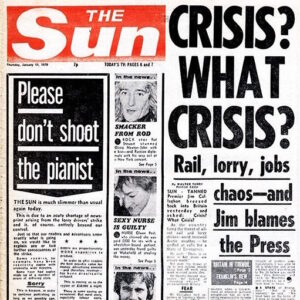
Parishioners of a certain vintage – or, like myself, of a certain level of political nerdery – may recall the famous January 1979 headline from The Sun newspaper, associating the phrase “Crisis? What crisis?” with then-Prime Minister Jim Callaghan. In the popular imagination it was credited with being a major factor in the Labour Government’s downfall, and the election of Margaret Thatcher’s Conservatives in May of that same year.
Britain in 2025 may not be in the same level of chaos, but it feels like every one of its major institutions is facing a crisis of its own. The BBC, which this week lost its Director General and Director of News, just as it prepares for its charter renewal, at a time when the media landscape around it has utterly transformed, has to face challenging questions of purpose, governance and values.
The NHS is struggling with astronomical waiting lists, chronic underfunding and overstretched resources. The monarchy is trying to minimise the damage from Andrew Mountbatten Windsor’s actions, and divisions between William and Harry. And meanwhile the Labour and Conservative parties – which at that 1979 election commanded a fairly typical combined vote share of over 80% – are currently polling at just over 30% combined.
The only bright spot with so many crises, it seems, is that each one takes the focus off another (and I’ve not even mentioned the armed forces, the civil service, the police force…)
And, of course, the Church of England is no exception to this. As I wrote here about a month ago, in 2023 its General Synod voted by a slim majority in all three houses (bishops, clergy and laity) to approve in principle for clergy to be able to enter into same-sex civil marriages, and to be allowed to offer standalone services of prayer and dedication for same-sex couples who had had a civil wedding elsewhere. However, the process chosen to follow requires a two-thirds majority in each house, which is unlikely to be achieved.
We have the unusual situation where many of the largest and wealthiest parish churches nationwide (and even here in our local Oxford deanery) have leadership strongly opposed to marriage equality, and indeed consider it a “first order” issue (i.e. a fundamental part of the faith, about which there can be no compromise). However, national polling consistently shows that a (growing) majority of Anglican churchgoers and members support inclusion – increasing to over 70% if focused on under-50s. None of this bodes well for the future of the Church of England on many levels.
Yet if the national picture feels bleak, the local story is far brighter. Transformation in the Church is rarely top‑down; it grows through communities like ours, where faith is lived out in welcome, worship, and service. Here in our benefice we have two churches with different contexts and priorities, but united in values of inclusion, openness, and beauty of worship – from our choirs, to our partnerships with Phil & Jim School, the Gatehouse, and the St Margaret’s Institute, and much more besides.
The wider Church has often been renewed not by institutions, but by people inspired to make God’s love in Jesus real where they are, from St Francis to John Wesley to Desmond Tutu. Renewal begins when individuals embody Christ’s love in their own time and place, even when the wider Church hesitates.
For all its failings and imperfections, I love the Church of England and believe its disappearance would be a great loss. Yet whatever happens in the months and years ahead, God will still be God, Christ will still love us, and the Spirit will still inspire. Our calling is not to despair at the failings of institutions, but to be attentive to the Spirit’s work among us, and to join in wherever love is already stirring.