
This is part of a series exploring some of the labels that we use in the Church of England and more generally – you can explore the whole series by clicking here.
The label “catholic” within Anglicanism can be confusing for a few reasons. To begin with: it has a broader meaning of “universal”, which is why the Nicene Creed – as referenced in the title of this piece, and used by Christians of all stripes and colours – uses the word.
But slightly more specifically, some people and churches also use the label “Catholic Anglican” (or its more traditional version “Anglo‑Catholic”). So why has St Margaret’s historically described itself – and been described as – sitting in the catholic tradition of the Church of England, while St Giles’ has not?
To answer that fully would involve delving into the social and religious history of England (and north Oxford) since the sixteenth century. I recognise that not everyone enjoys this quite as much as I do, so I’ll try to keep things a little more contemporary.
To begin: it’s not a coincidence that “catholic” in this specific sense uses the same word as the largest Christian denomination in the world. Catholic Anglicans tend to emphasise the continuity (rather than the disruption) of the Church of England with the medieval Catholic Church in England, particularly the continuing line of bishops back to the early Church (the so-called “apostolic succession). They also share many theological instincts with contemporary Roman Catholicism. Exactly how many of those instincts (as well as which ones) a person or parish shares will vary widely; as I mentioned in the first post in this series, all of these labels are broad, and often surprisingly so.
Catholic Anglicans are, inevitably, divided over many things. Perhaps most famously, they split on the question of the ordination of women in the 1990s. Many (like myself) welcomed it; others opposed it on theological principle, for reasons similar to those laid out by the Roman Catholic Church; while still others were not opposed in theory, but didn’t believe that the Church of England had the authority to make such a change to the priesthood on its own.
Other fun topics for discussion at Anglo‑Catholic dinner parties include same‑sex marriage (as in the wider Church of England); the precise theology of the sacraments, especially the Eucharist; the relationship between church and state; which form of liturgy and lectionary to use; and what colour to use in Advent and Lent (St Margaret’s opting for the bold choice of deep blue!).
But it is perhaps more useful to talk about the characteristics Catholic Anglicans tend to share, rather than the issues on which they differ. As we will see with other traditions as well, none of these features are unique to Catholics, but they are often emphasised more strongly in this tradition than in others.
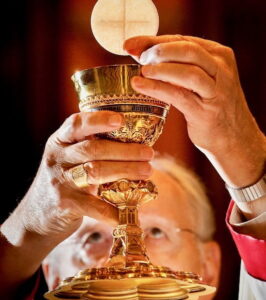
The first is the centrality of the sacraments to the Christian life, and particularly the Eucharist. While there is no single agreed understanding of what the Eucharist “means”, Catholic Anglicans generally hold that more is happening than a symbolic memorial, and that it should be the principal weekly service for the Christian community (and, if possible, received more often than weekly).
Flowing from this is a more elaborate form of celebrating and honouring the Eucharist. This is why, at St Margaret’s, you will see things like chasubles, servers, the reserved sacrament, bells and, on occasion, incense and acolytes (candle‑bearers) – none of which you will see at St Giles’. The president at the Eucharist is also more likely (depending on the individual) to use “manual actions” (hand motions) during the Eucharistic prayer to emphasise certain moments – although now that both churches share the same clergy, this distinction is less pronounced than it once was.
Catholic‑minded Anglicans often approach Scripture differently from Christians with a more Protestant outlook. It is not that Scripture is unimportant, but rather that it is rich and complex, and needs to be understood through the lens of the Christian community (i.e. the Church). Particularly important here are the theologians of the early Church (the “patristic” period), who helped shape the creeds and clarify the Christian faith in the first seven great “ecumenical” Church Councils. Nevertheless, Scripture remains of vital importance in the life of prayer of each Christian – in the daily office and the Eucharist, and also in practices such as lectio divina and Ignatian imaginative prayer.
This leads to what I would consider the most important emphasis in the catholic tradition: a stress on the communal, rather than individual, aspects of salvation. The focus is less on a singular conversion event or a purely personal relationship with Jesus, and more on God’s transformation of all creation – earthly and heavenly – and our role as human beings within that process.
All of the above is, of course, greatly simplified (which will be a common theme across these posts), but hopefully a fair introduction. If you would like some further reading, I’d recommend an obscure but entertaining history called Something Other Than We Are: An Informal History of Catholic Ideals in the Church of England by James Rattue (you can download it as a free PDF from the author’s website, or order a printed copy).
Next week: liberalism!
Was there anything that surprised you in this (very brief) overview? Are there aspects of the catholic tradition that attract you, or that you don’t agree with? Feel free to leave a comment below.